Hamburg
Germany's largest container port and a major rail hub in its own right, with strong connections into central and eastern Europe.

Country guide · China → Germany
Sea into Hamburg, Bremerhaven, and Wilhelmshaven, rail into Duisburg and Hamburg, air into Frankfurt and Munich. Germany is the one major lane where rail freight is a genuinely mainstream choice rather than a curiosity, and the ATLAS declaration and 19 percent import VAT are what shape the landed cost.
Sea port-to-port range
China–Europe rail range
Einfuhrumsatzsteuer
North Sea gateways
Gateways
Germany's advantage is depth of options. The same cargo can reach a Bavarian warehouse by ship, train, or aircraft, and the right answer is usually decided by the date rather than the rate.
Germany's largest container port and a major rail hub in its own right, with strong connections into central and eastern Europe.
High-capacity North Sea alternative to Hamburg, often useful when Elbe congestion or draft is a factor.
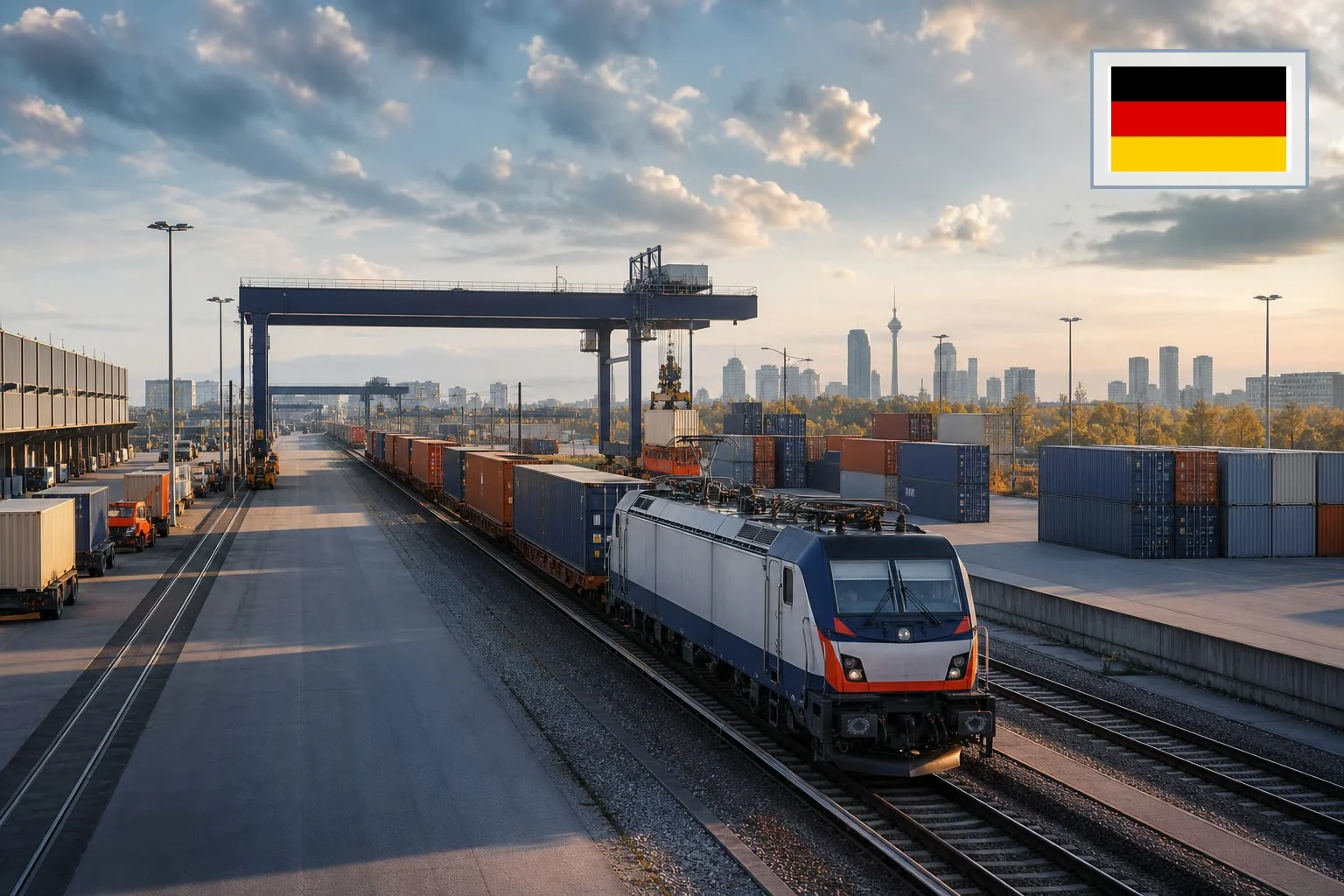
The main European end of the China–Europe rail corridor, with onward trucking across Germany and the Benelux.
Frankfurt is one of Europe's largest cargo airports, with wide capacity including dangerous goods handling.
Mode planner
On most corridors the choice is ocean or air. Into Germany, rail sits properly in the middle — roughly half the sea transit at a fraction of the air rate — which makes it the default answer for volume that cannot wait five weeks.
| Mode | Planning range | Best for |
|---|---|---|
| Air freight | 3–7 days | Launch stock and urgent replenishment |
| Express courier | 3–7 days | Samples, spares, small parcels |
| Rail freight | 18–22 days | Europe-bound volume that cannot wait for the ocean |
| Sea FCL | 28–38 days | Planned volume, lowest cost per unit |
| Sea LCL | +5–8 days | Smaller or multi-supplier volume |
German & EU customs
Germany applies the EU Union Customs Code and the EU common tariff, but declarations go through ATLAS, the German national system. Import VAT is 19 percent and, unlike the UK, is normally paid or deferred at import rather than postponed to a return — which changes how much cash the shipment ties up.
| Requirement | Who handles it | When |
|---|---|---|
| EU EORI number | Importer — mandatory | Before first import |
| ATLAS declaration | Broker — Prodoer coordinates | At import |
| TARIC commodity code | Broker — Prodoer | Before entry |
| EU common customs tariff duty | Importer | At entry |
| Import VAT 19% | Importer, deferment possible | At entry |
| ICS2 advance cargo data | Carrier | Pre-arrival |
| CE marking and product compliance | Importer, product dependent | Before sale |
| ISPM 15 timber packaging | Shipper | At packing |
How the lane runs
We price all three on your actual volume and date. On this lane that comparison genuinely changes the answer rather than confirming the obvious.
Sailing, block train, or flight booked, with the invoice, packing list, and TARIC classification prepared to the deadline.
Vessel, train, or flight milestones in one thread, including the border gauge change on rail movements.
Declaration, duty, and import VAT, then trucking from the port or terminal to your receiving window.
By sea, 28–38 days port to port into Hamburg or Bremerhaven. By rail, 18–22 days terminal to terminal, which is the reason rail is genuinely popular on this lane. By air, 3–7 days door to door. Add collection, customs, and onward trucking to any of those for the door-to-door figure.
More often than importers expect. It runs at roughly half the ocean transit for a fraction of the air rate, which suits volume that missed the sailing cut-off but cannot justify flying. The caveats are real though: capacity fluctuates, winter temperatures across the corridor can be severe for sensitive goods, and some dangerous-goods categories are restricted. We quote rail alongside sea and air rather than treating it as a novelty.
Duty follows the EU common customs tariff based on your TARIC classification, so it is the same rate you would pay entering any EU member state. German import VAT — Einfuhrumsatzsteuer — is 19 percent. Unlike the UK's postponed accounting, this is generally paid or deferred at import, which means the shipment ties up more cash. Under DDP we settle both and quote one landed number.
You need an EU EORI number, but it does not have to be German. An EORI issued by any member state is valid throughout the union, so if you already hold one from another EU country it will work for a German import. What you do need is clarity on who the importer of record is, because that determines who is liable for the duty and VAT.
We coordinate the ATLAS declaration through a broker, prepare the full document set, and arrange onward trucking from the port or rail terminal to your address. Whether the delivery needs a dock, a tail-lift, or a forklift is worth telling us at quote time, since it changes the vehicle and the price rather than being a detail to resolve on the day.
China → Germany lane quote
Send the cargo, German destination, and target date. One agent replies with all three modes priced on the same lane, plus the duty and import VAT position.
Send the cargo, German destination, and target date. One agent replies with all three modes priced on the same lane, plus the duty and import VAT position.