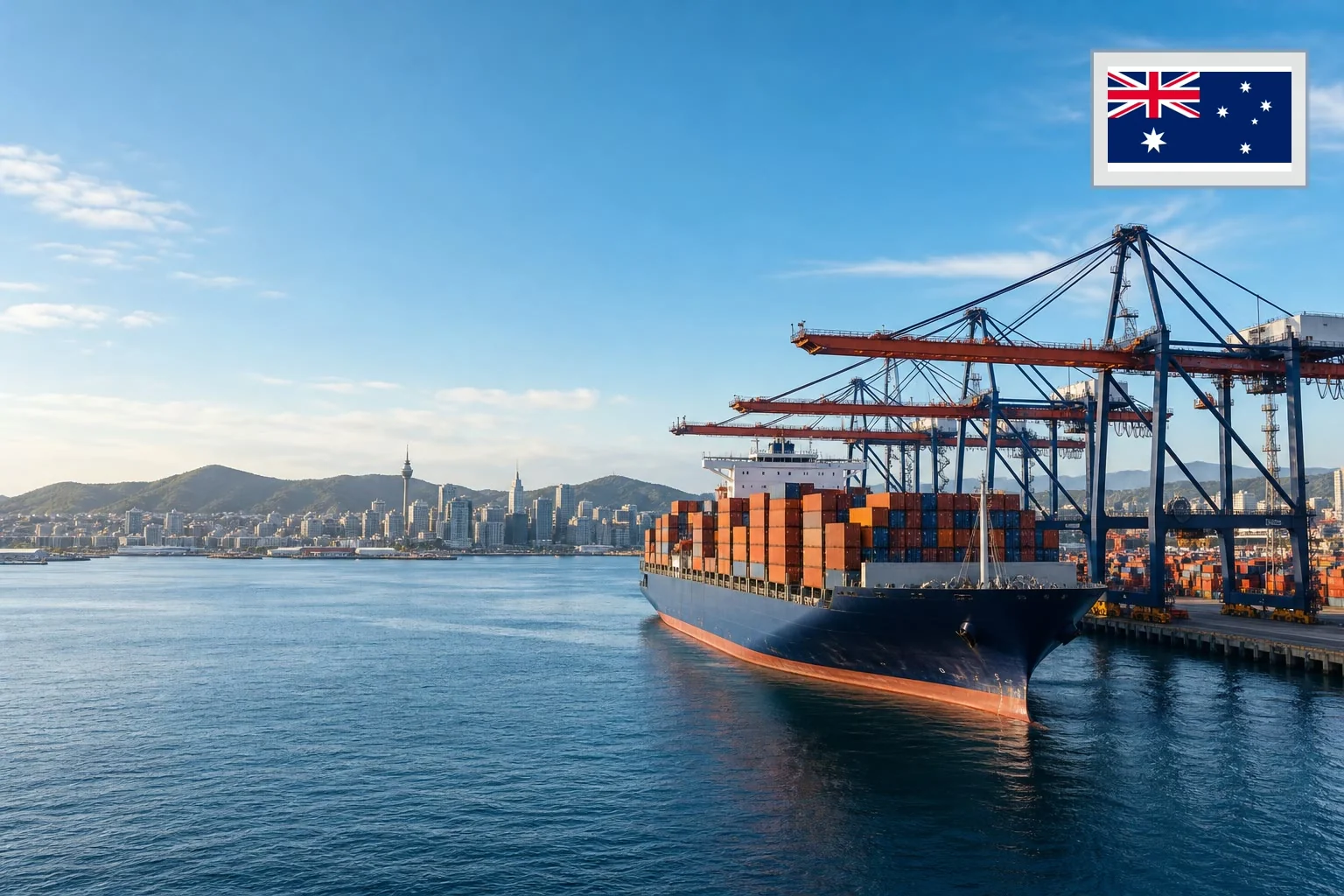
Sydney — Port Botany
The largest container gateway, serving New South Wales and much of the eastern seaboard.

Country guide · China → Australia
Ocean into Sydney, Melbourne, Brisbane, and Fremantle, plus air into the same cities. Australian imports clear two agencies, and the one that causes delays is rarely the Border Force: DAFF biosecurity inspects timber packaging, container cleanliness, and seasonal pest risk, and a fumigation order at the wharf is expensive.
Sea port-to-port range
GST on most imports
Australian gateways
Seasonal pest window
Gateways
Australia's population is concentrated in a few coastal cities, so the port choice usually follows the delivery city rather than a routing calculation.
The largest container gateway, serving New South Wales and much of the eastern seaboard.
Australia's busiest container port by volume, serving Victoria and onward into South Australia.
The Queensland gateway, with good access to the state's fast-growing distribution corridors.
Western Australia's port, serving Perth and the mining and resources supply chains.
Mode planner
Australia is a comparatively short ocean run from South China, which makes sea freight attractive for a wider range of cargo than on the Europe or US east coast lanes.
| Mode | Planning range | Best for |
|---|---|---|
| Air freight | 3–7 days | Launch stock and urgent replenishment |
| Express courier | 3–7 days | Samples, spares, small parcels |
| Sea FCL — Sydney / Melbourne | 18–24 days | Planned volume to the east coast |
| Sea FCL — Brisbane / Fremantle | 18–26 days | Queensland and Western Australia |
| Sea LCL | +5–8 days | Smaller or multi-supplier volume |
Australian customs & biosecurity
The Australian Border Force handles duty and GST, which is routine. DAFF biosecurity is where shipments actually get held: untreated timber packaging, soil or plant residue in a container, and seasonal pest measures all trigger inspection, treatment, or re-export. We check the packing at origin, because fixing it at the wharf costs far more.
| Requirement | Who handles it | When |
|---|---|---|
| ISPM 15 treated timber packaging | Shipper — checked at origin | At packing |
| Container cleanliness, no soil or residue | Shipper — checked at loading | At loading |
| Seasonal pest treatment where applicable | Shipper, before departure | Sep–Apr window |
| Import declaration | Broker — Prodoer coordinates | At import |
| Duty per Australian tariff | Importer | At entry |
| GST 10% | Importer | At entry |
| Permits for regulated goods | Importer, product dependent | Before shipping |
| Accurate packing declaration | Shipper | With documents |
How the lane runs
Timber packaging treatment, container condition, and whether the commodity falls inside the current seasonal pest measures.
Packing is corrected at origin where needed and the packing declaration is prepared to match what is actually in the container.
Vessel milestones and berth in one thread, with the biosecurity direction flagged as soon as it is issued.
Import declaration, duty and GST, any inspection attended, then trucking to the receiving window.
By sea, 18–24 days port to port into Sydney or Melbourne and 18–26 days into Brisbane or Fremantle, plus five to eight days for LCL consolidation. By air, 3–7 days door to door. Australia is a relatively short ocean run from South China, which makes sea freight viable for cargo that would need air on a Europe lane.
Almost always biosecurity rather than customs. DAFF inspects for untreated timber packaging, soil and plant residue in or on the container, and pests. A direction to fumigate, clean, or in the worst case re-export is issued at the wharf, when your options are limited and every day is accruing storage. It is the reason we check packing and container condition at origin instead of trusting a supplier's assurance.
ISPM 15 is the international standard for treating timber packaging — pallets, crates, and dunnage — against pests, evidenced by a stamp on the timber. Australia enforces it strictly. Untreated or unmarked timber is one of the most common causes of a held container, and it is entirely avoidable: we verify the marking at origin, and where a supplier cannot produce compliant timber we switch the packing method.
Brown marmorated stink bug measures apply to specified goods shipped during roughly September to April and can require treatment before the vessel departs China. The target goods list and the exact dates are set for each season, so the answer for your commodity this year may differ from last year. We check the current requirement at booking, because treatment has to happen before departure and cannot be retrofitted.
Duty depends on your tariff classification, and GST of 10 percent applies to most imports calculated on the value of the taxable importation. Low-value consignments are treated differently, which matters for e-commerce parcels but rarely for commercial freight. Under DDP we settle duty and GST and quote one landed number.
China → Australia lane quote
Send the cargo, Australian destination, and packing details. One agent replies with the port comparison, the biosecurity screening result, and the duty and GST position.
Send the cargo, Australian destination, and packing details. One agent replies with the port comparison, the biosecurity screening result, and the duty and GST position.