Tokyo / Yokohama
The main Kanto gateways for Tokyo, Saitama, Chiba, and eastern Japan distribution.

Country guide · China → Japan
Compare sea, air, express, DDP, and door delivery into Tokyo, Yokohama, Osaka, Kobe, Nagoya, and Fukuoka. The sailing is short; the real planning work is matching the importer, tariff code, invoice, and advance cargo data before the shipment reaches Japan.
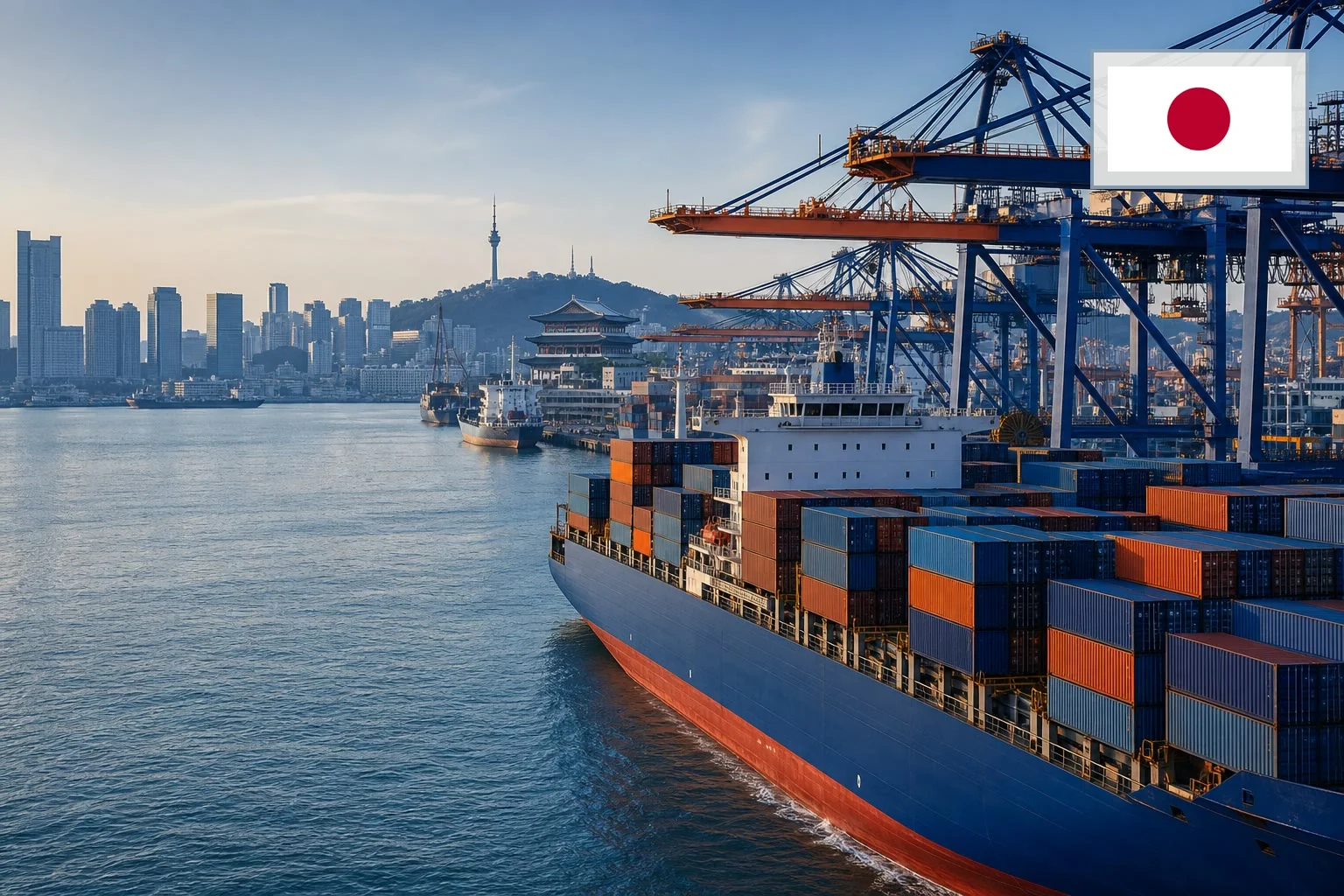
core sea gateways
cargo airports planned
standard import consumption tax
owner from pickup to delivery
Gateways
A shorter sailing is not automatically the lowest landed route. Destination handling and domestic trucking can change the decision.
The main Kanto gateways for Tokyo, Saitama, Chiba, and eastern Japan distribution.
The Kansai pair for Osaka, Kyoto, Hyogo, and western Japan warehouse delivery.
A practical gateway for Aichi and Chubu manufacturing supply chains.
Air options are selected by airline acceptance, cutoff, and the consignee's delivery postcode.
Japan mode planner
Ranges below are operational planning guides and exclude unusual customs exams, port disruption, and remote-area delivery. We confirm the live schedule and cutoff in the quote.
| Mode | Planning range | Best fit |
|---|---|---|
| Express courier | 2–5 days door to door | Samples, spares, and compact parcels |
| Air freight | 1–3 days airport to airport | Launch inventory and higher-value cargo |
| Sea FCL | 3–8 days port to port | Planned container volume |
| Sea LCL | 5–12 days port to port | Smaller or multi-supplier consignments |
| Door / DDP | Quoted by mode and postcode | One accountable pickup-to-delivery scope |
Japan customs
Japan Customs accepts electronic declarations through NACCS. Commercial imports normally need the importer and declaration data aligned with the invoice, packing list, and transport document.
| Input | Why it matters | When |
|---|---|---|
| Japanese importer / customs agent | Names the party responsible for the import declaration | Before booking |
| Commercial invoice + packing list | Supports value, description, quantity, and package count | Before departure |
| B/L or AWB | Links the declaration to the transport movement | Before arrival |
| HS classification | Determines duty and product controls | Before quote finalisation |
| Certificate or permit | Needed only where origin preference or product regulation applies | Product dependent |
How the lane runs
Set the Japanese importer, delivery postcode, and who pays duty and consumption tax before selecting DAP or DDP.
Reconcile the invoice, packing list, HS description, carton count, and any regulated-product document.
Choose the sailing, flight, or courier cutoff against the receiving date and track each handoff.
Coordinate the broker response, tax payment, release, and final delivery appointment.
Official references
These authority pages support the customs and marketplace guidance above. Product-specific eligibility still needs a shipment review.
Official declaration flow and the supporting documents Customs may require.
Open official sourceOfficial advance filing rules for maritime container cargo information.
Open official sourceOfficial explanation of customs duty and Japan's standard and reduced consumption-tax rates.
Open official sourceAs a planning guide, direct sea services are commonly 3–8 days port to port, airport-to-airport air freight 1–3 days, and express 2–5 days door to door. Origin pickup, consolidation, customs, and final delivery sit outside a port-to-port figure.
Start with the commercial invoice, packing list, bill of lading or air waybill, importer details, and HS classification. A certificate of origin, inspection certificate, licence, or other permit is added when the product or tariff treatment requires it.
Do not assume it can. Japan Customs publishes a customs-procedure-agent route for non-resident importers, but the commercial, tax, and product-regulatory setup must be confirmed before the shipment is sold as DDP.
Yes. We can quote supplier pickup, prep, import clearance, and appointment delivery against the Amazon.co.jp shipment plan. The consignee and importer setup must be valid before dispatch.
No. Japan Customs describes exemptions and simplified procedures with conditions and exclusions. The shipment value, commodity, channel, and declaration structure all matter, so do not split or label orders simply to target an exemption.
Japan lane quote
Share the origin, Japanese postcode, cargo profile, importer status, and target date. We will compare the workable sea, air, express, and door options.
Share the origin, Japanese postcode, cargo profile, importer status, and target date. We will compare the workable sea, air, express, and door options.