Free zone storage
Goods held in a designated free zone are under duty suspension. Nothing is payable while they stay there, which suits stock awaiting onward sale.

Country guide · China → UAE
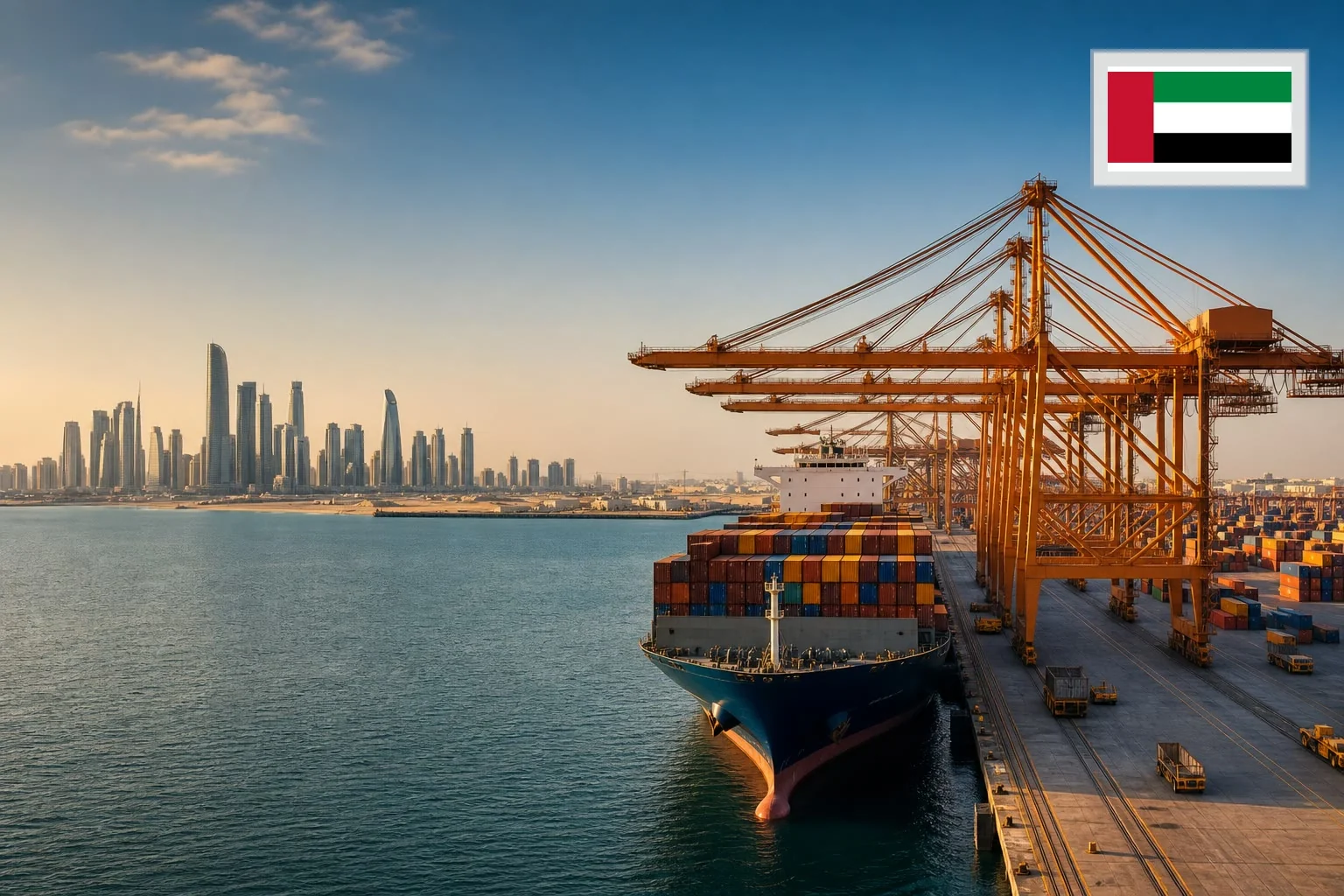
Ocean into Jebel Ali, Khalifa Port, and Sharjah, plus air into Dubai and Abu Dhabi. The question that decides your duty bill is not the tariff rate, which is low. It is whether the goods stay in a free zone under duty suspension or cross into the mainland, because that is the moment duty becomes payable.
Sea port-to-port range
Import duty, most goods
VAT on mainland import
UAE sea gateways
The decision that sets your duty
The UAE is a re-export hub as much as a consumption market, and its customs treatment reflects that. Getting the structure right is worth more than negotiating the freight rate.
Goods held in a designated free zone are under duty suspension. Nothing is payable while they stay there, which suits stock awaiting onward sale.
Moving goods into the local market triggers import duty and VAT. This is the point at which the importer needs a trade licence and customs code.
Cargo passing through to another GCC state, Africa, or the subcontinent, handled under transit procedures rather than import.
Mode planner
The UAE is a short ocean run from China via the Indian Ocean, and Dubai's air capacity is among the largest in the world — so both modes are genuinely competitive here.
| Mode | Planning range | Best for |
|---|---|---|
| Air freight | 3–6 days | Launch stock, high value, re-export cargo |
| Express courier | 3–6 days | Samples, spares, small parcels |
| Sea FCL — Jebel Ali | 18–24 days | Planned volume and free-zone storage |
| Sea FCL — Khalifa / Sharjah | 19–25 days | Abu Dhabi and northern emirates delivery |
| Sea LCL | +5–8 days | Smaller or multi-supplier volume |
UAE customs & compliance
UAE clearance is efficient when the paperwork is right and unforgiving when it is not. The importer must hold a valid trade licence and customs code, and the commercial documents need to match the declaration exactly — mismatches between invoice, packing list, and certificate of origin are the usual cause of delay.
| Requirement | Who handles it | When |
|---|---|---|
| Valid trade licence | Importer — mandatory | Before first import |
| Customs client code | Importer — mandatory | Before first import |
| Customs declaration | Broker — Prodoer coordinates | At import |
| Certificate of origin | Shipper, attestation may be required | With documents |
| GCC common tariff duty 5% | Importer, on mainland entry | At entry |
| VAT 5% | Importer, on mainland entry | At entry |
| Free zone versus mainland decision | Importer, set before arrival | Before arrival |
| Product conformity where applicable | Importer, product dependent | Before sale |
How the lane runs
We establish where the goods are going and what that means for duty, VAT, and which entity needs to be on the declaration.
Invoice, packing list, and certificate of origin are checked against each other before the vessel sails, since mismatches cause the delays here.
Jebel Ali, Khalifa, or Sharjah against the delivery point and the storage plan.
Declaration, duty and VAT if entering the mainland, then delivery to the zone, warehouse, or onward carrier.
By sea, 18–24 days port to port into Jebel Ali and 19–25 days into Khalifa Port or Sharjah, plus five to eight days for LCL consolidation. By air, 3–6 days door to door into Dubai or Abu Dhabi. Dubai's air cargo capacity is among the largest in the world, so air availability is rarely the constraint on this lane.
It is the difference between duty suspended and duty payable. Goods stored in a designated free zone sit under suspension — nothing is due while they remain there, which is why the UAE works so well as a re-export hub. The moment goods move into the mainland for local sale, import duty and VAT become payable and the importer needs a trade licence and customs code. Decide which applies before the cargo arrives, not after.
Duty is generally 5 percent under the GCC common tariff for most goods, with certain categories treated differently. VAT is 5 percent and applies on mainland import. Both are suspended for goods held in a free zone. Compared with most markets these rates are low, which is exactly why the structural question matters more than the rate.
To import into the mainland, the importer of record needs a valid UAE trade licence and a customs client code, so yes — some form of local entity or an arrangement with one. Free-zone storage and pure transit movements work differently. Tell us your commercial setup at quote time and we will confirm what the declaration needs rather than discovering it when the vessel is alongside.
Yes, and it is one of the main reasons to route through the UAE. Cargo can be held in a free zone and re-exported to other GCC states, East Africa, or the subcontinent without ever entering the UAE market. That is handled under transit or re-export procedures rather than import, and it changes both the documentation and the duty position, so tell us the eventual destination up front.
China → UAE lane quote
Send the cargo, destination, and whether the goods are going to a free zone or the mainland. One agent replies with the gateway comparison and the duty position for that structure.
Send the cargo, destination, and whether the goods are going to a free zone or the mainland. One agent replies with the gateway comparison and the duty position for that structure.