Vancouver
The primary Pacific gateway with the widest sailing choice and onward rail and trucking across the country.

Country guide · China → Canada
Ocean into Vancouver, Prince Rupert, Montreal, and Halifax, plus air into Toronto and Vancouver. The step that catches most new importers is not freight at all: CBSA now requires importers to register on the CARM portal and post their own financial security before cargo can be released.
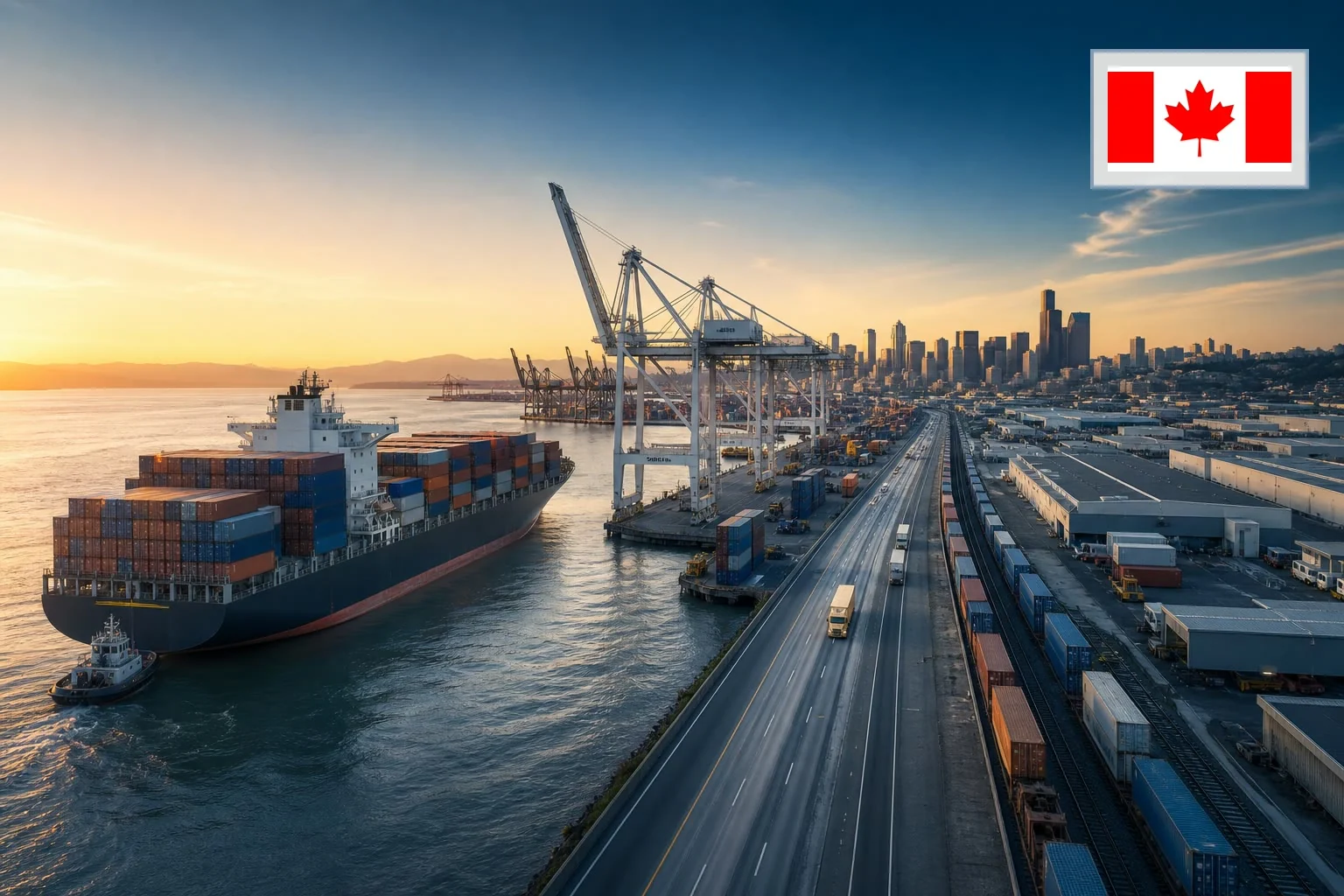
Vancouver / Prince Rupert FCL
Montreal via Panama
GST on most imports
Gateways quoted
Gateways
Canada is the clearest example of a lane where the fastest ocean leg is not always the cheapest landed cost — the inland leg does the deciding.
The primary Pacific gateway with the widest sailing choice and onward rail and trucking across the country.
The shortest sailing from Asia to North America, purpose-built for rail transfer inland with typically low dwell.
Via Panama. Lands the container in central Canada and removes the transcontinental rail leg entirely.
Pearson and YVR for time-sensitive cargo, with onward delivery to warehouse, 3PL, or retail.
Mode planner
The west coast is materially faster from China than the east. If the delivery address is in Ontario or Quebec, the choice is between a short sail plus a long rail leg, or a long sail straight to Montreal.
| Mode | Planning range | Best for |
|---|---|---|
| Air freight | 3–7 days | Launch stock and urgent replenishment |
| Express courier | 3–7 days | Samples, spares, small parcels |
| Sea FCL — Vancouver | 13–18 days | Western Canada, or rail onward to Ontario |
| Sea FCL — Prince Rupert | 13–17 days | Direct rail connection inland, lower congestion |
| Sea FCL — Montreal | 30–38 days | Quebec and Ontario delivery without the rail leg |
| Sea LCL | +5–8 days | Smaller or multi-supplier volume |
Canadian customs & compliance
CBSA's Assessment and Revenue Management system changed how importers of record are set up. You now need to be registered on the CARM Client Portal with your own financial security in place — a forwarder cannot simply lend you theirs. We confirm your position before booking, because discovering it at the border is expensive.
| Requirement | Who handles it | When |
|---|---|---|
| CARM portal registration | Importer — mandatory | Before first import |
| Financial security posting | Importer, via CARM | Before release |
| Business Number with import account | Importer | Before first import |
| eManifest / ACI advance data | Carrier | Pre-arrival |
| HS classification | Broker — Prodoer coordinates | Before entry |
| Duty per Canadian Customs Tariff | Importer | At entry |
| GST 5% | Importer | At entry |
| ISPM 15 timber packaging | Shipper | At packing |
How the lane runs
Before anything is booked we check that you are registered, have security posted, and hold a Business Number with an import account.
Classification drives duty and GST. We confirm it and flag any permit or labelling requirement for the commodity.
Vancouver, Prince Rupert, or Montreal, chosen against the delivery address and the cost of the inland leg.
Broker entry, duty and GST, then rail or trucking to your warehouse, 3PL, or retail address.
CARM is CBSA's Assessment and Revenue Management system, and yes — importers of record must be registered on the CARM Client Portal and post their own financial security before goods can be released. This replaced the older arrangement where importers could effectively rely on a broker's bond. It is the single most common reason a first Canadian shipment stalls, so we verify your registration status before booking rather than after arrival.
By sea, 13–18 days to Vancouver and 13–17 days to Prince Rupert, or 30–38 days to Montreal via Panama. By air, 3–7 days door to door into Toronto, Vancouver, Montreal, or Calgary. Add origin pickup, customs, and final-mile delivery to any ocean figure, and remember that a Vancouver arrival bound for Toronto still needs several days of rail.
Both work and the answer is a cost comparison rather than a rule. Vancouver gives a much shorter ocean leg but adds a transcontinental rail or trucking leg. Montreal roughly doubles the sailing time but lands the container far closer to Ontario. Prince Rupert is worth quoting too, since it is built around rail transfer and often has lower dwell. We price all three against your address.
Duty is set by your classification under the Canadian Customs Tariff, and GST of 5 percent applies to most imports. Depending on the province and the goods, provincial sales tax may apply as well. Under DDP we settle duty and GST and quote one landed number; otherwise they are payable by you as importer of record at entry.
We prepare and coordinate the full document set — commercial invoice, packing list, classification, and importer details — and work with a licensed Canadian broker for the entry. What we cannot do is act as your importer of record or post your CARM security; those sit with your business by design. We tell you clearly which parts are ours and which are yours.
China → Canada lane quote
Send the cargo, destination, and your CARM registration status. One agent replies with compared gateways, the duty and GST position, and the clearance plan.
Send the cargo, destination, and your CARM registration status. One agent replies with compared gateways, the duty and GST position, and the clearance plan.