
Quick answer: can you ship power banks from China by air?
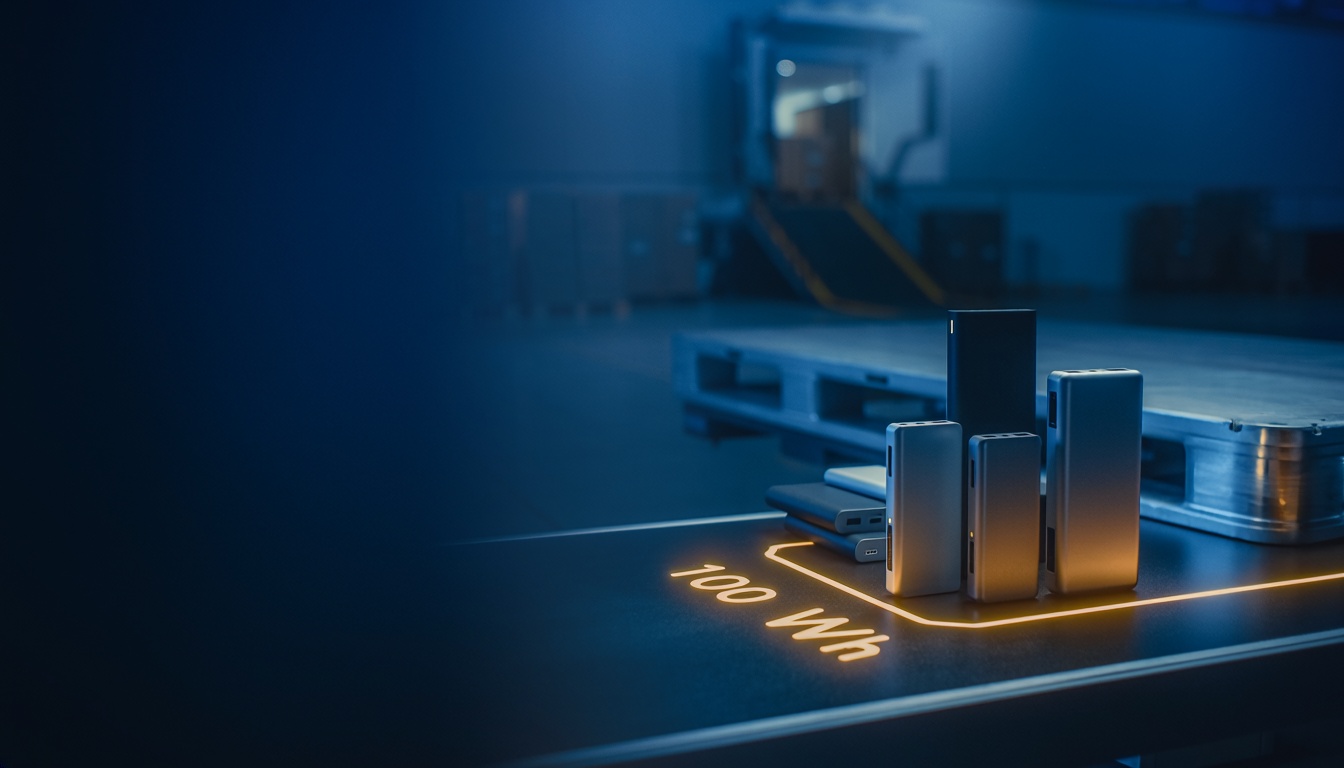
Yes — but as standalone lithium-ion batteries (UN 3480), which means cargo aircraft only, at or below 30% state of charge, under full Class 9 handling. The single number that shapes the route is 100 watt-hours: at or below 100 Wh, a power bank ships under the lighter Section IB provisions; above 100 Wh, it is fully regulated Section IA. Watt-hours also decide the sea freight fallback. What you may know as the 100 Wh airport rule is a passenger rule — the cargo thresholds are different rules that happen to land on the same number.
Why a power bank is never "a battery packed with equipment"
Sellers regularly assume a power bank ships as UN 3481 — a battery packed with or contained in equipment — because it exists to charge other devices. The regulations read it the other way: a power bank is itself the battery being shipped, so it classifies as UN 3480, lithium-ion batteries shipped standalone. That single classification drives everything else in this guide, and misdeclaring it as 3481 is one of the most common rejection causes we see. The UN number decision guide walks the same logic for every product type.
The 100Wh line, in practical terms
Watt-hours are printed on compliant power banks — use the marked rating, not a calculation, whenever it exists. If you need the math: Wh = (mAh × nominal voltage) ÷ 1000, so a 20,000 mAh pack at 3.7 V is 74 Wh, and roughly 27,000 mAh at 3.7 V is where the 100 Wh line sits.
Power bank rating | By air (PI 965) | Package limit | What it means operationally |
|---|---|---|---|
≤ 100 Wh | Section IB — the lighter standalone path, but still Class 9 with Cargo Aircraft Only | 10 kg of batteries per package | Most consumer power banks land here; lighter paperwork, wider airline acceptance |
> 100 Wh | Section IA — fully regulated | 35 kg per package | Fewer accepted lanes, closer review, higher handling cost |
Any rating | Passenger aircraft: forbidden as cargo — freighters only | — | A cheaper passenger-aircraft rate is never an option for UN 3480 |
Any rating | State of charge 30% or below at tender | — | Factory ships packs part-charged; buyers recharge on arrival |
Two notes on that table. First, Section IB is "lighter," not "light-touch": the carton still carries the Class 9 model 9A label, the Cargo Aircraft Only label, and the lithium battery mark — the label size rules apply without discounts. Second, the 100 Wh line you have met at airports is a passenger carry-on rule (below 100 Wh generally fine, 100–160 Wh with airline approval, above that forbidden in the cabin). It is not the cargo rule — but for standalone lithium-ion by air, the cargo sections split at the same 100 Wh, which is why the number follows power banks everywhere.
What air freight actually requires
The document pair. A UN 38.3 test summary for the exact power bank model, and an SDS matching its chemistry and watt-hour rating. These are the documents to gather before asking for an air rate — the airline asks for them at acceptance, not after.
UN-specification packaging. Inner packing, a carton built to the standard, and the three marks above applied at the specified sizes.
State-of-charge control at the factory. Packs tendered above 30% SoC get rejected at the warehouse, not renegotiated at the terminal.
A lane that accepts UN 3480. Airlines apply individual battery policies on top of the regulations. Consolidated dangerous-goods air freight out of Shenzhen, Guangzhou, and Hong Kong is the standard route; the battery shipping service page describes how the lane review works before booking.
When air is wrong: the sea fallback
Power banks above 100 Wh, large volumes, or profiles the airlines decline all move by sea under the IMDG Code:
≤ 100 Wh power banks qualify for the special provision 188 relief — lithium battery mark, a compliance note on the document, up to 30 kg gross per package, and far less friction than air.
> 100 Wh ship fully regulated with the Class 9 label and the DG declaration — more paperwork than the relief path, but sea acceptance for standalone batteries is the widest of any mode.
Sea costs a fraction of air per kg and takes weeks instead of days. For replenishment inventory it is the default; for a launch or a stockout, air earns its premium. The wider trade-off between "regulated but routine" and "actually blocked" is laid out in can you ship batteries from China — power banks are the textbook "routine" case once the rating is honest.
Why couriers keep saying no
Express networks run parcel sortation and passenger-belly lift, both hostile to standalone lithium-ion. Their published battery programs cover batteries packed with or inside equipment — UN 3481 — not UN 3480. A seller shipping power banks by courier is either refused at pickup or, worse, moved on a misdeclaration that fails at the hub scan. Small-quantity sellers have three honest options: consolidated DG air through a forwarder, sea LCL, or restructuring the product to ship the power bank with its equipment as a genuine UN 3481 consignment.
FAQ
Is a 20,000mAh power bank over the limit?
No — 20,000 mAh at 3.7 V nominal is about 74 Wh, under the 100 Wh line. It ships by air under Section IB. Always confirm against the Wh rating marked on the pack, which is the number regulators and carriers use.
Can power banks fly on passenger planes as cargo?
No. Power banks are UN 3480, forbidden as cargo on passenger aircraft. They fly on freighters under the Cargo Aircraft Only label.
Do power banks really need UN 38.3?
Yes. Standalone batteries are fully regulated, and the test summary for the exact model is the first document the airline reviews. A factory that cannot produce it stops the shipment before a rate discussion starts.
What state of charge should power banks ship at?
30% or below for air freight. The factory controls this at packing; packs tendered above the limit are rejected.
Sources
IATA, Lithium Battery Shipping Guidance — PI 965 sections, SoC and aircraft rules.
49 CFR 173.185 (eCFR) — the US lithium battery rule for the destination leg.
UN Manual of Tests and Criteria (UNECE) — the UN 38.3 test reference.
FAA, Hazardous Materials — Lithium Batteries — air-side safety context.
PHMSA, Lithium Batteries — US guidance and enforcement.
The watt-hour rating on the label decides the route, the package limit, and the cost shape. Send the profile — model, marked Wh rating, quantity, and destination — and the route answer comes back within 24 hours.