
Last updated: September 2026
Lithium battery shipping labels are two distinct marks, not one. A Class 9 hazard label — a 100 mm × 100 mm diamond — is required on fully regulated shipments, while a rectangular lithium battery mark (minimum 100 mm × 100 mm, reducible to 100 mm × 70 mm) covers smaller, exempted batteries. Which one applies depends on chemistry and UN number — UN 3480/3481 for lithium-ion, UN 3090/3091 for lithium metal — per the 2026 IATA DGR and the IMDG Code.
Get the mark wrong and the package is refused at the airport or held at the port. A labeling error is the cheapest and most common reason a lithium battery shipment stalls, and every figure below is the number a carrier or authority actually checks at acceptance. If you are planning a battery shipment out of China, start with our battery shipping hub, which maps the packing relationships and document review behind these labels.
Two marks: the Class 9 label vs the lithium battery mark
Most shippers treat "lithium battery label" as one sticker. It is actually two, and they are not interchangeable:
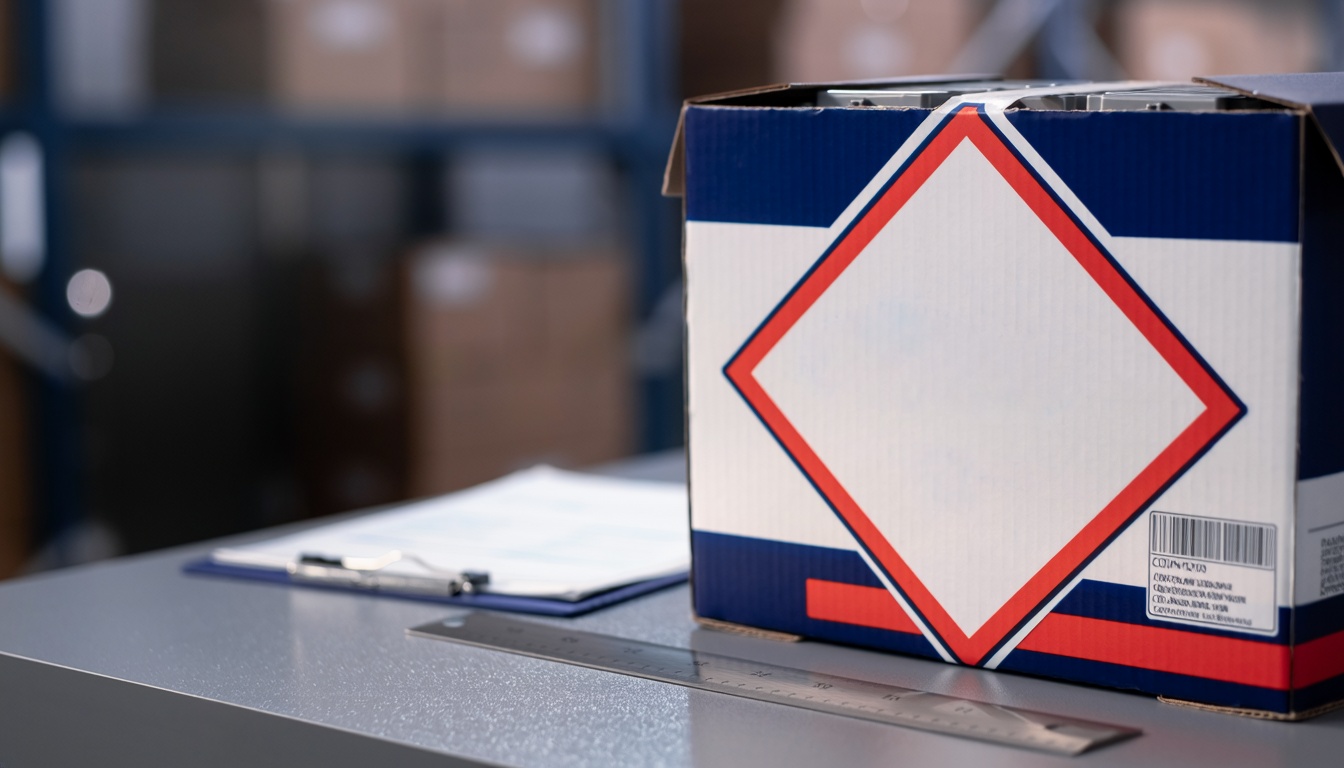
Class 9 hazard label (model 9A). A square-on-point diamond with seven black vertical stripes in the upper half and a battery-group symbol — one cell broken and emitting flame — above a black "9" in the lower half. It marks a fully regulated shipment.
Lithium battery mark. A rectangle or square with a red hatched border and the battery-group symbol above the UN number. It marks a smaller or exempted shipment.
Class 9 label (model 9A) | Lithium battery mark | |
|---|---|---|
Shape | Diamond (square on point) | Rectangle or square |
Minimum size | 100 mm × 100 mm | 100 mm × 100 mm, reducible to 100 mm × 70 mm |
Key elements | 7 black stripes, battery group, "9" | Red hatched border, battery group, UN number |
Applies to | Fully regulated (air Section I / IB; sea Class 9) | Air Section II; sea Special Provision 188 |
Lithium battery mark: size and design rules
The mark (IATA DGR Figure 7.1.C, section 7.1.5.5; IMDG Code 5.2.1.9) must meet these specifications under the 2026 IATA DGR and the IMDG Code:
Element | Requirement |
|---|---|
Minimum dimensions | 100 mm × 100 mm |
Reduced size (small packages only) | Not less than 100 mm wide × 70 mm high |
Border | Red diagonal hatching, minimum 5 mm wide |
Symbol | Battery group with one damaged cell emitting flame, black on white or a contrasting background |
UN number | At least 12 mm high, printed inside the mark and preceded by "UN" |
Telephone number | No longer required (IATA removed it in 2023; IMDG permits it only through 31 December 2026) |
The reduced 100 mm × 70 mm size is permitted only when the package physically cannot bear the full-size mark. If any face of the package is large enough for the full 100 mm × 100 mm mark, you must use the full size.
Class 9 label: size rules and when it is required
The Class 9 hazard label must be a square set at 45° (a diamond), minimum 100 mm × 100 mm on each side (IMDG Code 5.2.2.2.1.1; US 49 CFR 172.407(c)(1)). Where the package is too small to bear a full-size label, the dimensions may be reduced proportionally as long as the symbol and other elements remain clearly visible (IMDG Code 5.2.2.2.1.1.3; 49 CFR 172.407(c)(1)(i)).
Two design points cause real rejections:
Use model 9A, the lithium-battery-specific Class 9 label (battery group above the "9"). The generic "miscellaneous" Class 9 label was disallowed for lithium batteries and must not be used.
For air, fully regulated standalone batteries must also carry the Cargo Aircraft Only label, because UN 3480 and UN 3090 are forbidden as cargo on passenger aircraft.
Lithium-ion batteries: UN 3480 and UN 3481
Lithium-ion (rechargeable) batteries split into two UN numbers based on how they ship:
UN 3480 — LITHIUM ION BATTERIES, shipped on their own (standalone cells and packs). This is the most tightly controlled case.
UN 3481 — LITHIUM ION BATTERIES PACKED WITH EQUIPMENT or CONTAINED IN EQUIPMENT. "Packed with" means the battery is in the same carton as the device but not installed; "contained in" means it is installed inside the device.
By air (IATA DGR):
Configuration | Packing Instruction | Label / mark required |
|---|---|---|
Standalone, fully regulated | PI 965 Section IA | Class 9 label + Cargo Aircraft Only |
Standalone, small (cells ≤20 Wh, batteries ≤100 Wh) | PI 965 Section IB | Class 9 label + Cargo Aircraft Only + lithium battery mark |
Packed with / contained in equipment, fully regulated | PI 966 / PI 967 Section I | Class 9 label |
Packed with / contained in equipment, small | PI 966 / PI 967 Section II | Lithium battery mark |
Note the standalone change: Section II of PI 965 was removed, so standalone lithium-ion batteries by air now ship only under Section IA or IB — Section IB is the "small battery" path, and it still requires the Class 9 label and the Cargo Aircraft Only label in addition to the mark.
By sea (IMDG Code): fully regulated UN 3480/3481 shipments carry the Class 9 label, UN number, and proper shipping name. Batteries within the Special Provision 188 limits — cells ≤20 Wh and batteries ≤100 Wh — are exempted from most requirements but must still bear the lithium battery mark, with "lithium batteries in compliance with special provision 188" stated on the transport document.
Lithium metal batteries: UN 3090 and UN 3091
Lithium metal (non-rechargeable) batteries use the same packing-relationship logic under different UN numbers:
UN 3090 — LITHIUM METAL BATTERIES, shipped on their own.
UN 3091 — LITHIUM METAL BATTERIES PACKED WITH EQUIPMENT or CONTAINED IN EQUIPMENT.
By air (IATA DGR):
Configuration | Packing Instruction | Label / mark required |
|---|---|---|
Standalone, fully regulated | PI 968 Section IA | Class 9 label + Cargo Aircraft Only |
Standalone, small (cells ≤1 g lithium, batteries ≤2 g) | PI 968 Section IB | Class 9 label + Cargo Aircraft Only + lithium battery mark |
Packed with / contained in equipment, fully regulated | PI 969 / PI 970 Section I | Class 9 label |
Packed with / contained in equipment, small | PI 969 / PI 970 Section II | Lithium battery mark |
As with lithium-ion, Section II of PI 968 was removed, so standalone lithium metal batteries by air ship only under Section IA or IB.
By sea (IMDG Code): fully regulated UN 3090/3091 shipments carry the Class 9 label. The Special Provision 188 exemption (cells ≤1 g lithium, batteries ≤2 g lithium) removes the Class 9 label but still requires the lithium battery mark and the SP 188 compliance note.
The four UN numbers at a glance
UN number | Chemistry | Packing relationship | Proper shipping name |
|---|---|---|---|
UN 3480 | Lithium-ion (rechargeable) | Standalone | LITHIUM ION BATTERIES |
UN 3481 | Lithium-ion (rechargeable) | Packed with / contained in equipment | LITHIUM ION BATTERIES PACKED WITH / CONTAINED IN EQUIPMENT |
UN 3090 | Lithium metal (non-rechargeable) | Standalone | LITHIUM METAL BATTERIES |
UN 3091 | Lithium metal (non-rechargeable) | Packed with / contained in equipment | LITHIUM METAL BATTERIES PACKED WITH / CONTAINED IN EQUIPMENT |
New in the 2026 DGR and IMDG Code 42-24: sodium-ion batteries use UN 3551/3552 and follow a parallel structure, outside the four lithium UN numbers above. For a deeper read on how chemistry and packing relationship determine the UN number, see our lithium battery industry page.
Placement and packaging rules that get shipments rejected
Even with the right mark, these placement mistakes cause refusals at acceptance:
Mark or label folded over a corner or edge. The label must sit flat on one face, not wrap around the package.
Mark hidden by an overpack. If an overpack covers the marks, the marks must be reproduced on the outside of the overpack (or the word "OVERPACK" shown where inner marks remain visible).
Using the generic Class 9 "miscellaneous" label. Lithium batteries need model 9A with the battery group symbol.
UN number below 12 mm or missing the "UN" prefix. The number must be legible and preceded by "UN" (for example "UN 3480").
Assuming the telephone number is still required. It has been phased out — including it is not a failure, but it is no longer required under IATA and is only permitted through 31 December 2026 under IMDG.
FAQ
What is the minimum size of a lithium battery shipping label?
The lithium battery mark must be at least 100 mm × 100 mm, reducible to 100 mm wide × 70 mm high only when the package is too small for the full mark. The Class 9 hazard label must be at least 100 mm × 100 mm on each side.
What is the difference between the Class 9 label and the lithium battery mark?
The Class 9 label is a diamond-shaped hazard label (model 9A) used on fully regulated shipments, while the lithium battery mark is a rectangular handling mark with a red hatched border used on smaller and exempted shipments (air Section II, sea Special Provision 188).
Which UN number is lithium-ion vs lithium metal?
Lithium-ion (rechargeable) uses UN 3480 (standalone) and UN 3481 (packed with or contained in equipment). Lithium metal (non-rechargeable) uses UN 3090 (standalone) and UN 3091 (packed with or contained in equipment).
Do all lithium battery packages need a Class 9 label?
No. Fully regulated shipments need the Class 9 label, but smaller batteries shipped under air Section II or sea Special Provision 188 use only the lithium battery mark.
Is a telephone number still required on the lithium battery mark?
No. IATA removed the requirement in 2023, and the IMDG Code permits a telephone number only through 31 December 2026 — it is no longer required under either code.
Can I print the lithium battery mark directly on the box?
Yes. The mark may be printed directly on the outer packaging as long as there is sufficient contrast between the mark and the packaging colour and all elements meet the size and design specifications.
Related planning guides
Sources
All sources retrieved 4 September 2026.
IATA — Lithium Battery Guidance Document (2026) — High (official IATA guidance; mark specifications, Packing Instructions 965–970).
IATA — DGR 67th Edition Addendum (2026) — High (official regulation text).
IMDG Code (IMO) — Part 5, marking and labelling — High (international code; 5.2.1.9 marking, 5.2.2.2.1.1 label dimensions, Special Provisions 188/230/310/376/377/384).
USDOT PHMSA — Lithium Battery Guide for Shippers and 49 CFR 172.407 / 173.185 — High (US regulation).
UNECE — UN Manual of Tests and Criteria, Section 38.3 — High.
IMDG Code Compliance Centre (Shashi Kallada) — Lithium battery marking, labelling and placarding — Medium-High (industry expert interpretation).
Daniels Training Services — Class 9 lithium battery label — Medium-High (specialist hazmat training).
Shipping lithium batteries from China? Get a battery shipping quote — send your chemistry, watt-hour rating, and packing relationship, and a specialist will map the workable route and confirm the exact marks your carton needs.