
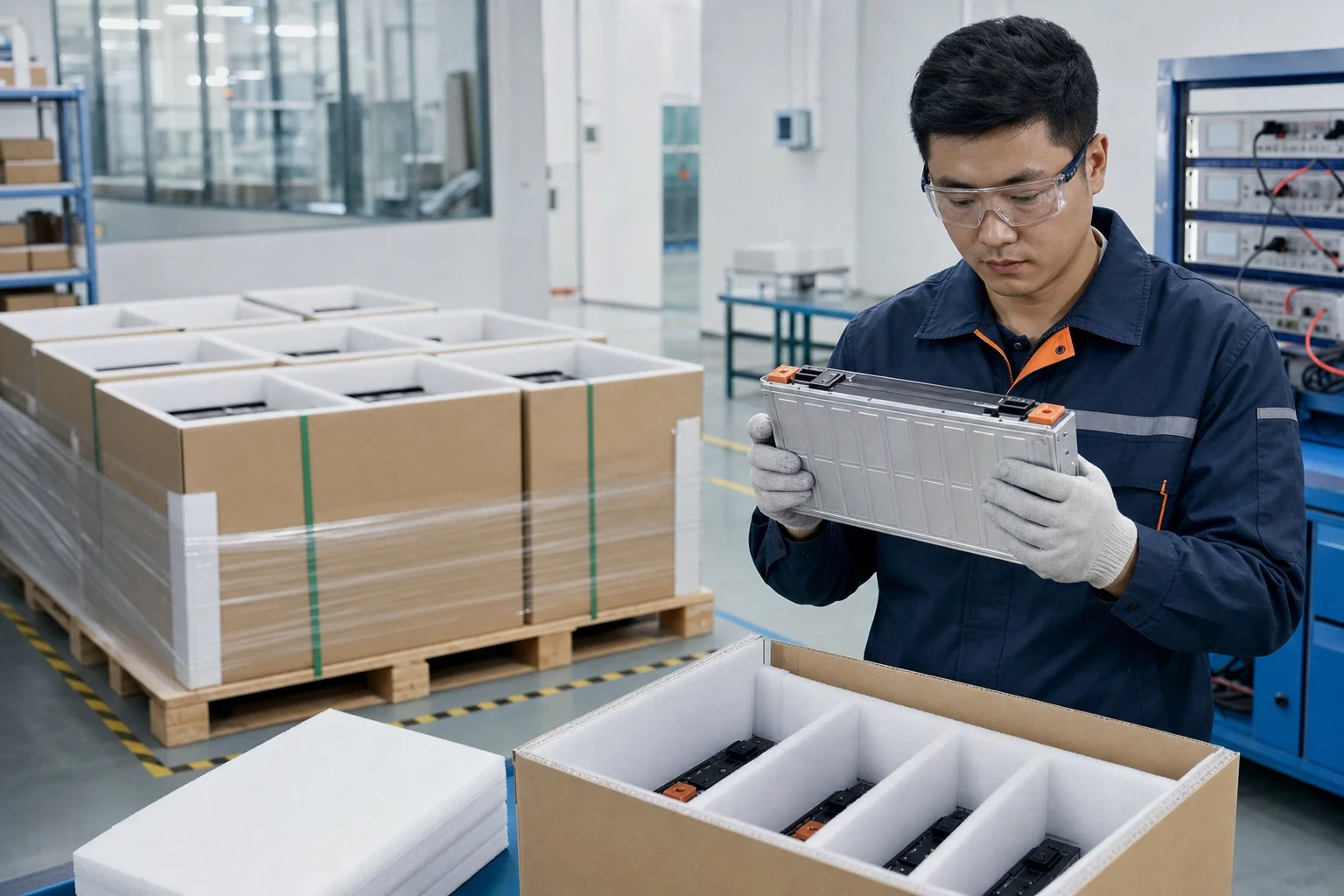
Quick answer: can I ship lithium batteries from China to the USA?
Yes — they move every day as Class 9 dangerous goods. Acceptance is decided by three things: the correct UN number and packing relationship (UN 3480 or 3481 for lithium-ion), a UN 38.3 test summary with a matching SDS, and the US layer — 49 CFR 173.185 on top of IATA or IMDG rules for the leg into the country. Air freight runs about 3–8 days on cargo aircraft; sea freight runs 13–35 days at a fraction of the per-kg cost. The premium you pay is dangerous-goods handling, packaging, and documentation — not the freight alone.
This guide complements the battery shipping China to USA service page, which covers the operational handoff; here we focus on the rules, the route choice, and the cost lines behind the quote.
The rules that decide whether your shipment flies — or sails
Four questions decide how a China–US battery shipment is classified and accepted:
Question | The rule | What it changes for you |
|---|---|---|
Which UN number? | Chemistry plus packing relationship: UN 3480 standalone lithium-ion, UN 3481 packed-with or contained-in; UN 3090/3091 for lithium-metal | Labels, documents, package limits — see the UN number decision guide |
State of charge? | Standalone lithium-ion by air: 30% or below; from 1 January 2026, batteries packed with equipment (PI 966) also fly at or below 30% | Factory has to ship packs at reduced charge; plan recharge at destination |
Which aircraft? | UN 3480 is forbidden as cargo on passenger aircraft — Cargo Aircraft Only | The booking must be on a freighter product; a cheaper passenger-aircraft rate is a false economy |
What paper? | UN 38.3 test summary for the exact model, SDS, packing details — and for the US entry, invoice with HTS classification | No summary, no shipment; the UN 38.3 guide explains how to get one from the factory |
Two more US-specific points. First, once cargo is imported, the domestic leg — drayage, warehouse-to-buyer parcel or LTL — falls under DOT rules (49 CFR), so the battery profile has to survive the whole chain, not just the ocean or air leg. Second, at entry: most lithium-ion batteries classify under HTS heading 8507, and Section 301 tariffs apply to most Chinese lithium-ion batteries on top of the general rate. Confirm the current rate and program coverage with your broker before you cost the landed price — tariff lines on batteries have moved repeatedly.
The routes importers actually use
Air freight: 3–8 days, cargo aircraft only
Consolidated dangerous-goods air freight out of Shenzhen, Guangzhou, and Hong Kong into gateways such as Los Angeles, Chicago, and New York is the standard lane for replenishment stock and launches. Standalone batteries ship under Section IA (up to 35 kg per package) or Section IB (up to 10 kg) with the Class 9 and Cargo Aircraft Only labels; batteries packed with or inside equipment have more flexibility on aircraft choice and package counts. The air freight China to USA page covers the normal airport handoffs; the battery layer adds the DG acceptance review on top.
Sea freight: 13–35 days, the widest acceptance
Under the IMDG Code, ocean carriers accept the broadest range of battery profiles — including larger packs that struggle to find airline acceptance — at a per-kg cost far below air. FCL works for planned volume; LCL works for smaller consignments, with the same documentation. The sea freight China to USA page details the ocean process (ISF filing, destination charges); the battery layer adds the DG declaration and packaging review. Sea buys flexibility, not an exemption — the Class 9 paperwork still ships with the cargo.
Express: small, packed-with or contained-in only
Courier networks accept small shipments of batteries packed with or inside equipment under their battery programs, within per-piece limits. Standalone batteries are generally refused. Express works for samples and spares; it is not a channel for inventory.
Split shipments: the pragmatic answer
When part of an order is document-ready and part is not, splitting — flying the ready SKUs, holding the problem SKUs — protects the receiving date while the missing test summaries are chased. It costs a second handling fee and saves the season.
What the shipment actually costs
Cost line | What drives it | How it behaves |
|---|---|---|
Base freight | Chargeable weight by air; volume by sea | Market rates move with capacity and fuel |
DG surcharge | Dangerous-goods handling per shipment, set by the airline or shipping line | A fixed add-on that does not scale the way base freight does |
Packaging | UN-specification cartons, inner packing, labels and marks | Per-carton cost; often the smallest line and the most underestimated |
Documentation and review | UN 38.3 and SDS verification, DG declaration, booking on a battery-accepted lane | Fixed per shipment; the line that prevents the expensive lines |
US entry | Duty on HTS 8507 (plus Section 301 where applicable), merchandise processing fee, harbor maintenance fee for sea, brokerage | Determined by customs value and mode; check the what "all-in" should mean on a freight quote guide before comparing quotes |
No responsible forwarder publishes a battery rate table — acceptance conditions and surcharges change too quickly. What you should insist on is a quote that names every line above, so the comparison between air and sea, or between forwarders, is honest.
The checklist before you book
UN 38.3 test summary for the exact model — not a "similar" model, the model in the carton.
SDS matching chemistry and watt-hour rating.
Packing relationship confirmed carton by carton (standalone, packed with, contained in).
Outer packaging photos or the packaging spec, so the carton is approved before pickup.
Commercial invoice with HTS classification, and a broker briefed on the battery profile.
For sea: ISF filed at least 24 hours before loading.
The general China to USA corridor guide covers the customs and transit basics for any cargo; batteries add the document pair and the acceptance review on top.
Air or sea: the decision in one table
If your situation is… | …the usual answer is |
|---|---|
Launch or stockout risk, ≤ a few pallets | Air, cargo aircraft only, 3–8 days |
Steady replenishment, full cartons, 2+ weeks of cover | Sea FCL or LCL, 13–35 days |
Large packs or profiles airlines decline | Sea under IMDG |
Mixed order, part document-ready | Split shipment — fly the ready SKUs |
Samples, spares, small packed-with/contained-in | Express within courier battery limits |
FAQ
Do I need UN 38.3 to import lithium batteries into the USA?
Yes. The test summary is required by the transport rules for both air and sea, and US carriers and customs expect it as part of the battery profile. It is the single document whose absence stops the shipment.
How long does battery air freight take from China to the US?
Plan on 3–8 days airport to airport for the consolidated DG lane, plus handling at both ends. The battery profile does not change transit time much — it changes which flights you can book.
Are lithium batteries from China subject to Section 301 tariffs?
Most Chinese lithium-ion batteries under HTS 8507 have carried Section 301 tariffs on top of the general rate, and the applicable rates have been revised more than once. Treat the tariff line as a broker question for your exact HTS code and entry date, not an internet constant.
Can standalone lithium-ion batteries fly on passenger planes?
No. UN 3480 is forbidden as cargo on passenger aircraft and ships on freighters under the Cargo Aircraft Only label. Batteries packed with or inside equipment are the profiles with passenger-aircraft flexibility.
Sources
49 CFR 173.185 (eCFR) — the US lithium battery transport rule.
IATA, Lithium Battery Shipping Guidance — air packing instructions, SoC and aircraft rules.
PHMSA, Lithium Batteries — US DOT guidance and enforcement.
UN Manual of Tests and Criteria (UNECE) — the UN 38.3 test reference.
USTR, Section 301 Actions — tariff program background; confirm current rates with your broker.
CBP, Importer Security Filing (10+2) — the sea-filing requirement referenced above.
The cheapest mistake on this lane is quoting freight before the battery profile clears. Send the profile — chemistry, watt-hours, packing relationship, volume, and receiving date — and the rules, route, and cost answer comes back together.