
Last updated: September 2026
Ebike battery shipping from China works only as declared Class 9 dangerous goods: a typical 400–700 Wh pack is UN 3480 (shipped alone) or UN 3481 (packed with/contained in equipment), needs UN-spec packaging, a UN 38.3 test summary, and — by air — a state of charge at or below 30%. Standard couriers refuse these packs because their parcel networks are not certified to carry them. A dangerous-goods freight forwarder books them on compliant air, sea, or rail routes instead.
That is the short version. This guide breaks down the three things e-bike brands and importers actually ask about: what the shipment costs, how the battery must be packed, and why the courier at the counter keeps saying no. For the full mode-by-mode comparison across chemistries, see our battery shipping hub — this article stays focused on the e-bike pack specifically.
What you are actually shipping: the three classifications
Before anyone quotes a price, the battery has to be classified by how it sits relative to the bike. Getting this wrong is the single most common reason a shipment is refused at tender.
Configuration | UN number | Air packing instruction | What it means for you |
|---|---|---|---|
Spare battery shipped alone | UN 3480 | PI 965 | Strictest case: cargo aircraft only, ≤30% state of charge, fully regulated since 2022 |
Battery packed in the same box as the bike (not installed) | UN 3481 | PI 966 | Fully regulated Class 9; 30% SoC cap applies since 1 Jan 2026 |
Battery installed in the e-bike / vehicle | UN 3481 or vehicle entries (UN 3171 / UN 3556 series) | PI 967 / PI 952 | Vehicle entries were restructured in the 2025–2026 rulebooks; still declared DG by air |
Two numbers matter most for an e-bike pack:
Watt-hours. Typical packs run 300–1,000 Wh. The small-battery reliefs that let laptop and power-tool cells move under simplified Section II rules top out at 100 Wh — far below any e-bike pack. Above that, the shipment is fully regulated Class 9 (source: IATA Lithium Battery Guidance Document, 2026 edition; retrieved September 2026; credibility: High).
State of charge (SoC). Since 1 January 2026, the 30% SoC cap extends beyond standalone UN 3480 batteries to lithium-ion batteries packed with equipment (PI 966) above 2.7 Wh and to battery-powered vehicles, under Special Provision A331 of the IATA Dangerous Goods Regulations (67th edition, 2026) and the 2025–2026 ICAO Technical Instructions (sources: IATA Lithium Battery Guidance Document, retrieved September 2026, credibility High; IATA 2026 update summary, retrieved September 2026, credibility Medium).
Ocean freight under the IMDG Code (Amendment 42-24, in force 2026) carries no state-of-charge cap and no passenger-aircraft problem — which is why container-quantity e-bike inventory increasingly sails rather than flies (source: Platton, Shipping Lithium Batteries, retrieved September 2026, credibility Medium).
What e-bike battery shipping costs
There is no honest single number — the DG premium stacks on top of the base freight. What we can do is show you exactly which layers stack, so you can read any quote correctly.
DG freight premium. Carriers price battery cargo above general cargo because acceptance is narrower (freighter-only for UN 3480) and handling is certified. On lanes where freighter space is tight, that premium moves.
UN-specification packaging. Fully regulated shipments require UN performance-tested packaging (Packing Group II level for standalone batteries). Heavy packs ≥12 kg with strong, impact-resistant casings have an alternative strong-outer-packaging path, but air transport of that configuration needs Associate Administrator approval in US rules (source: PHMSA Lithium Battery Guide for Shippers, retrieved September 2026, credibility High).
Documents. UN 38.3 test summary, MSDS/SDS, Shipper's Declaration for Dangerous Goods where required, and destination import docs. Document preparation is a real line item, not a formality.
Marks and labels. Class 9 lithium battery label, lithium battery mark with UN number, Cargo Aircraft Only label for UN 3480 by air.
Time. DG acceptance cut-offs close earlier than general cargo, and a rejected declaration does not cost hours — it rolls the shipment to the next departure with acceptance and space, which on freighter-only lanes is measured in days. In practice, e-bike battery cargo runs roughly 5–7 days slower than general cargo on comparable lanes (practice-based observation from DG operations; no single public statistic — treat as typical, verify against your quote).
Cost decision rule of thumb: urgent samples and small commercial batches fly (30% SoC, full DG file); volume and must-arrive-charged inventory go by sea under IMDG with no SoC cap; China–Europe rail sits between the two where lane DG acceptance is confirmed.
Packing rules that decide acceptance
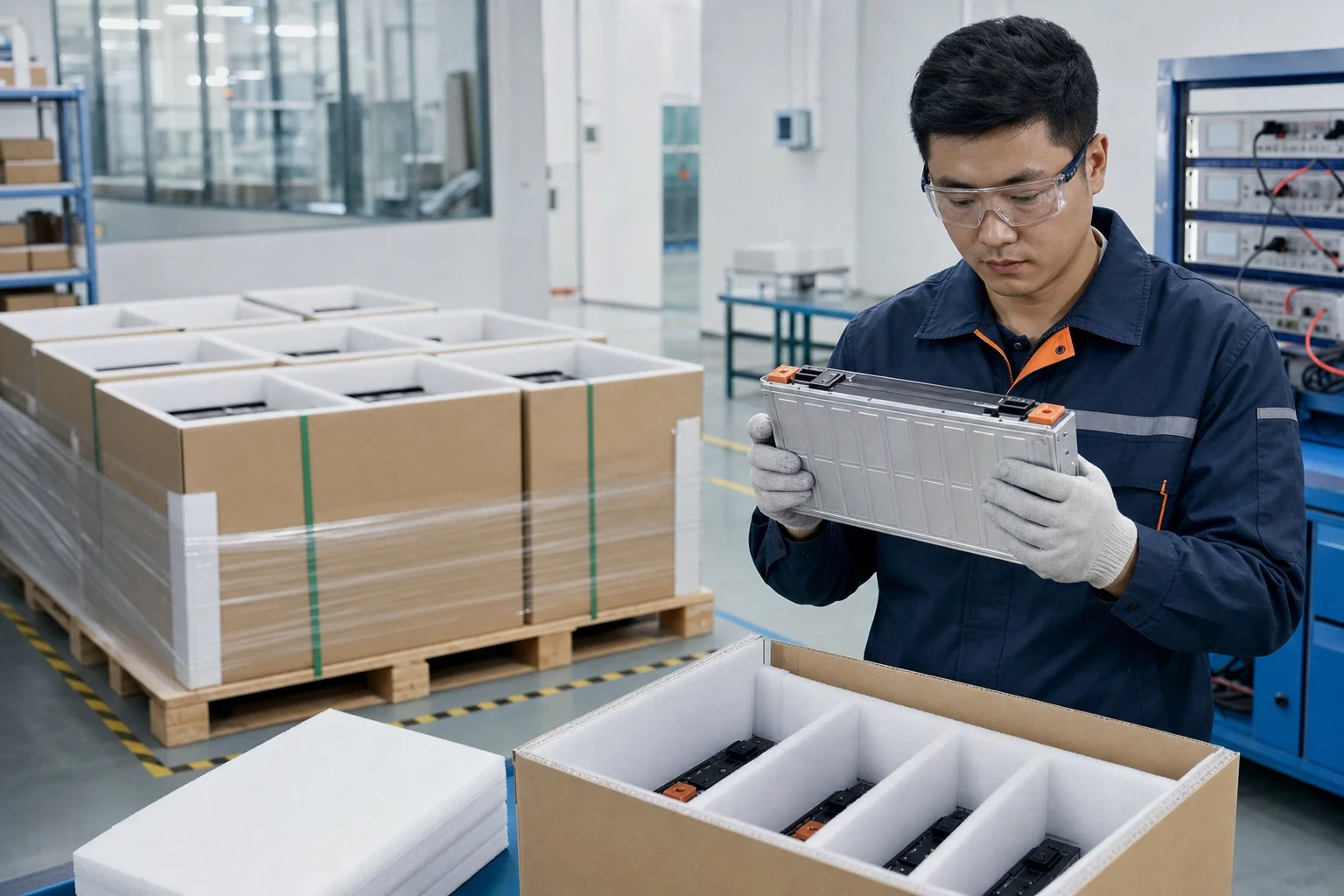
Packing failures are quiet — the shipment looks fine and gets refused anyway. The checklist a DG reviewer runs:
State of charge at or below 30% of rated capacity for air (PI 965; and, since 2026, PI 966 above 2.7 Wh and vehicles) — Special Provision A331 (IATA DGR 2026).
Terminal protection. Terminals protected against short circuit; non-conductive inner layers; no free movement inside the box.
UN-spec outer packaging for standalone batteries; net quantity capped at 35 kg of batteries per package for UN 3480 by air unless approved (IATA PI 965 / 49 CFR § 173.185 framework).
UN 38.3 test summary on file — the shipper legally declares the battery design passed the UN Manual of Tests and Criteria, Part III, sub-section 38.3.
Correct marks and labels matching the declared classification (see our lithium battery shipping labels guide for label sizes and placement).
No co-packing with incompatible DG. UN 3480 must not share outer packaging with explosives, flammable gases/liquids, flammable solids, or oxidizers (IATA DGR 2026).
A 630 Wh pack in a standard carton with taped terminals and no declaration is not a cheap shortcut — it is a shipment that will be detected, refused, and flagged.
Why couriers say no
If you have already been turned away — a counter refusal, an online booking cancelled after the battery was disclosed, a "lithium batteries not accepted" policy page — none of that means the battery cannot ship. It means that channel was never eligible:
Parcel networks are not DG-certified for this cargo. High-volume hub-and-spoke sortation is not built for Class 9 containment, and carrier insurance typically excludes battery-fire liability, so standard couriers refuse standalone lithium batteries outright or accept them only under pre-approved hazmat contract accounts (sources: Speedlink specialist guide, retrieved September 2026, credibility Medium; Envodrive CA/US compliance guide, retrieved September 2026, credibility Medium).
The big packs have no small-battery relief. A 400–1,000 Wh pack exceeds every simplified threshold; there is no "excepted" lane for it. Since 2022, every UN 3480 package ships fully regulated (source: IATA guidance, 2026 edition, credibility High).
Passenger aircraft are closed to UN 3480. All lithium-ion batteries shipped alone are forbidden as cargo on passenger aircraft (IATA DGR 2026; PI 965 Section IA/IB shipments additionally require the Cargo Aircraft Only label). Belly capacity — where parcel networks live — is simply not available.
Trained-shipper requirements. Whoever tenders the package must be DG-trained (e.g., 49 CFR § 172.704 in the US, TDG certificates in Canada). Almost no individual seller qualifies, and carriers will not accept Class 9 from a non-approved account (source: PHMSA / Transport Canada frameworks, credibility High).
Postal is closed. International mail prohibits lithium batteries beyond small cells installed in equipment — a 500 Wh pack is not mailable in any configuration (source: USPS Publication 52 § 349 via ParcelPath e-bike shipping guide, retrieved September 2026, credibility Medium).
The refusal is the system working. The compliant route exists — declared, packed, documented, and booked on a carrier whose acceptance policy covers your exact UN number. That is what a DG forwarder does.
Getting an e-bike battery quoted: what to send
To turn a refusal into a booked shipment, send your forwarder:
Battery spec: chemistry, watt-hours, Wh rating marks, and whether the pack ships alone, packed with, or installed
UN 38.3 test summary and MSDS/SDS from the manufacturer
Quantity, carton dimensions, gross weight, and pallet plan
Pickup city in China, destination country, delivery terms (DDP/DDU), and required transit time
With that file, the forwarder can classify, compare air/sea/rail DG routes, and quote a price that will actually hold at tender. Get a lane quote.
FAQ
Can I ship an e-bike battery by air from China?
Yes, as declared Class 9 dangerous goods on cargo aircraft only (UN 3480, PI 965), at ≤30% state of charge, with UN-spec packaging, UN 38.3 documentation, and a carrier whose acceptance policy covers the UN number. Passenger aircraft are closed to standalone lithium-ion batteries under the 2026 IATA DGR.
Why won't FedEx, UPS, or DHL take my e-bike battery at the counter?
Parcel carriers accept Class 9 lithium batteries only under pre-approved dangerous-goods contract accounts with trained shippers. A retail-counter standard parcel account is not eligible, and typical 400–700 Wh e-bike packs exceed every small-battery exception — so the counter refusal is regulatory, not discretionary.
Does the 30% state-of-charge rule apply to batteries packed with the bike?
Yes. Since 1 January 2026, the ≤30% SoC requirement extends to lithium-ion batteries packed with equipment above 2.7 Wh (PI 966) and to battery-powered vehicles, under Special Provision A331 of the IATA DGR (2026 edition). Ocean freight under the IMDG Code has no SoC cap.
Sea or air for bulk e-bike battery inventory?
Ocean, usually. IMDG shipments need a DG declaration and UN-spec packaging but carry no state-of-charge limit and no passenger-aircraft restriction, and container rates beat DG air for volume. Air remains the choice for urgent samples that can arrive at 30% charge.
How much slower is DG battery shipping than normal freight?
In practice, expect roughly 5–7 extra days versus general cargo on comparable lanes: earlier acceptance cut-offs, freighter-only routings for UN 3480, and rolls to the next accepted departure when a declaration is queried. (Practice-based observation; confirm against your quote.)
Can I ship the bike without the battery and source the pack locally?
Yes — that is a common workaround for one-off moves: the frame ships as general cargo, and the buyer sources a compatible pack in the destination country. For commercial imports the math usually still favors shipping batteries as declared DG at volume.
Sources (all retrieved September 2026):
IATA Lithium Battery Guidance Document, 2026 edition (PI 965/966/967, 30% SoC, SP A331, passenger-aircraft prohibition) — credibility: High
PHMSA, Lithium Battery Guide for Shippers (49 CFR 171–185, UN-spec packaging, 35 kg limit, CAO label) — credibility: High
Platton, Shipping Lithium Batteries: UN3480 & UN3481 Rules (IMDG Amdt 42-24, UN 3171/3556 vehicle entries, 2026 changes) — credibility: Medium
Envodrive, Shipping E-Bike Batteries in Canada and the US (carrier account requirements, trained-shipper rules) — credibility: Medium
Speedlink, Lithium Battery Courier Service: A Specialist Guide 2026 (why standard courier networks refuse) — credibility: Medium
ParcelPath, How To Ship An Electric Bike (USPS Pub 52 § 349, domestic ground exceptions, cost drivers) — credibility: Medium
Regulatory basis: IATA Dangerous Goods Regulations, 67th edition (2026), Packing Instructions 952/965/966/967 and Special Provisions A201/A331; IMDG Code, Amendment 42-24; UN Manual of Tests and Criteria, Part III, sub-section 38.3. Regulatory texts are paraphrased for readability — final compliance calls belong with your forwarder's DG specialist.